UK Food Temperature Compliance & HACCP Record-Keeping Guide
8th September 2026•By Neil Skoglund
Compliance Guide
If your business stores or transports chilled or frozen food - or temperature-sensitive pharmaceuticals - a fridge failure overnight or a delivery van left running too warm isn't just a quality problem. It's a food safety incident, and under UK law you're required to be able to show what happened, when, and what you did about it.
This guide covers what UK temperature compliance actually requires, why manual spot-checks leave gaps that continuous monitoring closes, and what to look for in a monitoring solution. For a walkthrough of one specific tracker built for this job, see our RAK2270 cold chain sticker tracker guide. For the full sensor range and dashboard, see our temperature monitoring platform.
Why Temperature Compliance Matters
Temperature control sits at the centre of food safety for one simple reason: most foodborne pathogens multiply fastest in what food safety guidance calls the "danger zone" - roughly 8°C to 60°C. Keep chilled food cold enough and hot food hot enough, and you starve that growth. Let it drift for long enough, and you can't always tell from looking, smelling, or tasting that anything went wrong.
That's why temperature compliance is treated as a legal obligation rather than a best practice in the UK - and why the consequences of getting it wrong go well beyond a batch of spoiled stock. They include:
Product loss and spoilage
A single overnight excursion in a cold store or delivery vehicle can write off an entire batch of stock, with no warning until someone opens the door the next morning.
Consumer and patient safety
Undetected temperature abuse of ready-to-eat food or temperature-sensitive medicines is a direct public health risk, not just a commercial one.
Regulatory and legal exposure
Environmental Health Officers can issue improvement notices, downgrade your Food Hygiene Rating, or in serious cases refer a business for prosecution when required records aren't being kept.
Audit and due diligence
If something does go wrong, complete records are your legal defence - proof you took "all reasonable precautions", a standard built into UK food safety law.
UK Temperature Requirements: What the Rules Actually Say
UK food temperature law sits across a few overlapping sources - EU law retained after Brexit, UK-wide statutory instruments, and FSA guidance that fills in the practical detail. The headline figures food businesses work to are:
Requirement
Standard
Source
Chilled food (E, W, NI)
8°C or below is the legal limit; FSA recommends running fridges at 5°C for a safety margin
Risk-based "no risk to health" standard rather than a fixed figure - 8°C/5°C used as the practical benchmark
Food Hygiene (Scotland) Regulations 2006
Frozen food
-18°C or below
FSA guidance
Documented safety management
A food safety management system based on HACCP principles is required for every food business
Article 5, Regulation (EC) No. 852/2004
There's also a general allowance to have chilled food out of temperature control for up to 4 hours (for display or service) before it must be discarded, and the food's own temperature is what's legally relevant - not just the air temperature around it. None of this is exhaustive legal advice; if you're unsure how the rules apply to your specific operation, check current Food Standards Agency guidance or speak to your local authority's Environmental Health team.
What HACCP-Style Record-Keeping Actually Requires
For most small and medium food businesses, the FSA's Safer Food Better Business (SFBB) pack is the practical way HACCP principles get applied - it isn't mandatory itself, but it's built to satisfy the same Article 5 obligation. Whatever format you use, an inspector expects to see the same underlying elements:
1
Identified critical points
Chilling, freezing, cooking, and reheating are the classic critical control points where temperature is what stands between safe and unsafe food.
2
Regular monitoring against a limit
A defined check - fridge and freezer temperatures at least twice a day is the standard SFBB pattern - against a stated limit (8°C, -18°C, or whatever applies).
3
Recorded evidence
A record of each check with the date and time, the equipment or product measured, the reading, who took it, and any corrective action - a "prove it" diary, spreadsheet, or sensor log.
4
Corrective action when a limit is breached
What you actually did when a fridge ran warm - moved stock, called an engineer, discarded product - recorded alongside the reading that triggered it.
5
Retention appropriate to the business
Regulation (EC) No. 852/2004 requires records "commensurate with the nature and size" of the business - the FSA leaves exact retention to you, based on shelf life, though many food safety consultants suggest keeping diaries for at least 12 months.
Manual Spot-Checks vs Continuous IoT Monitoring
A twice-daily paper diary satisfies the letter of the SFBB pattern, but it only ever captures two moments in a 24-hour period. Anything that happens between checks - a door left ajar overnight, a compressor failure over a weekend, a delivery van's fridge unit cutting out on a motorway - goes unrecorded until someone happens to notice.
Manual spot-checks
Continuous IoT monitoring
Coverage
2-3 readings/day, whenever staff remember
Reading every few minutes, 24/7, unattended
Out-of-hours gaps
Overnight, weekend, and holiday failures often go unnoticed until the next check
Alerts fire the moment a threshold is breached, any time of day
Record integrity
Paper or spreadsheet entries can be missed, backfilled, or disputed
Timestamped, tamper-resistant sensor data
Staff time
Manual rounds every day, every site, every unit
Set thresholds once; review by exception
In-transit visibility
Effectively none once the vehicle leaves the depot
Live temperature data throughout the journey
Continuous monitoring doesn't remove every manual check your food safety management system calls for - core-temperature "prove it" checks on cooked food, for instance, are still done with a probe - but for storage and transport it closes the exact gap where most undetected temperature abuse happens.
What to Look For in a Monitoring Solution
Configurable alerting
Thresholds you set per unit, with alerts by email, SMS, or push notification to the right person - not just a dashboard nobody's watching at 2am.
Data retention you control
Historical data kept for as long as your business needs it - matched to product shelf life and your own due diligence policy, not a vendor's default.
Exportable audit trails
Reports an Environmental Health Officer or customer auditor can be handed directly - readings, timestamps, and any alerts raised, without manual transcription.
Trend visibility
Graphs that show a fridge slowly drifting warmer over weeks - catching a failing compressor before it becomes an incident, not just after a breach.
Coverage in transit, not just storage
Sensors and connectivity that keep reporting once goods leave the depot, so cold chain visibility doesn't stop at the loading bay.
Fits your existing HACCP paperwork
Data that slots alongside your SFBB diary or food safety management system, rather than replacing it with something your team has to relearn.
How Trackpac Fits
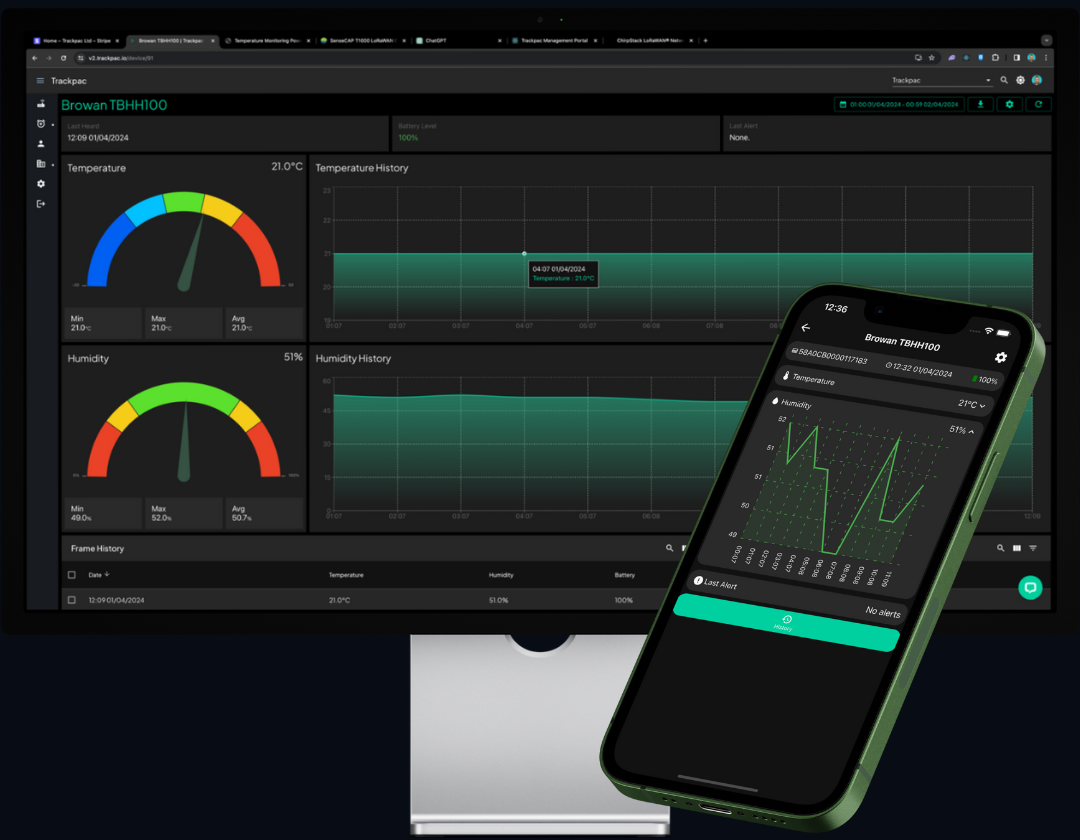
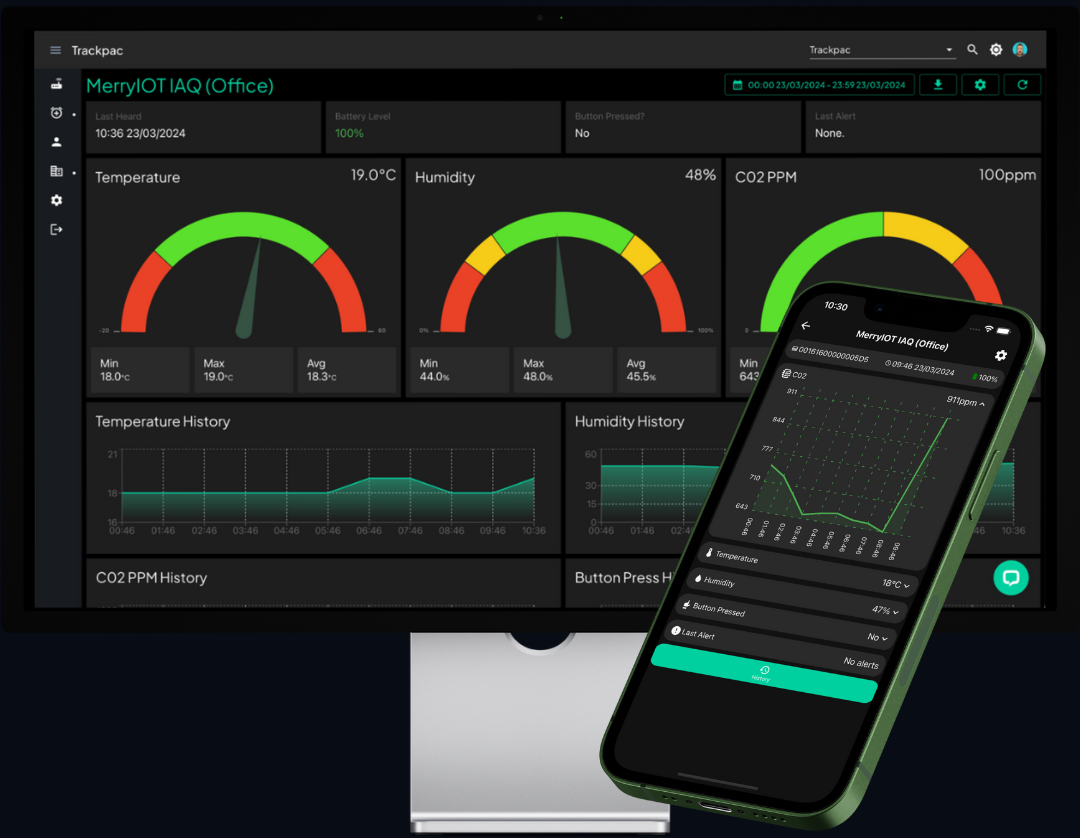
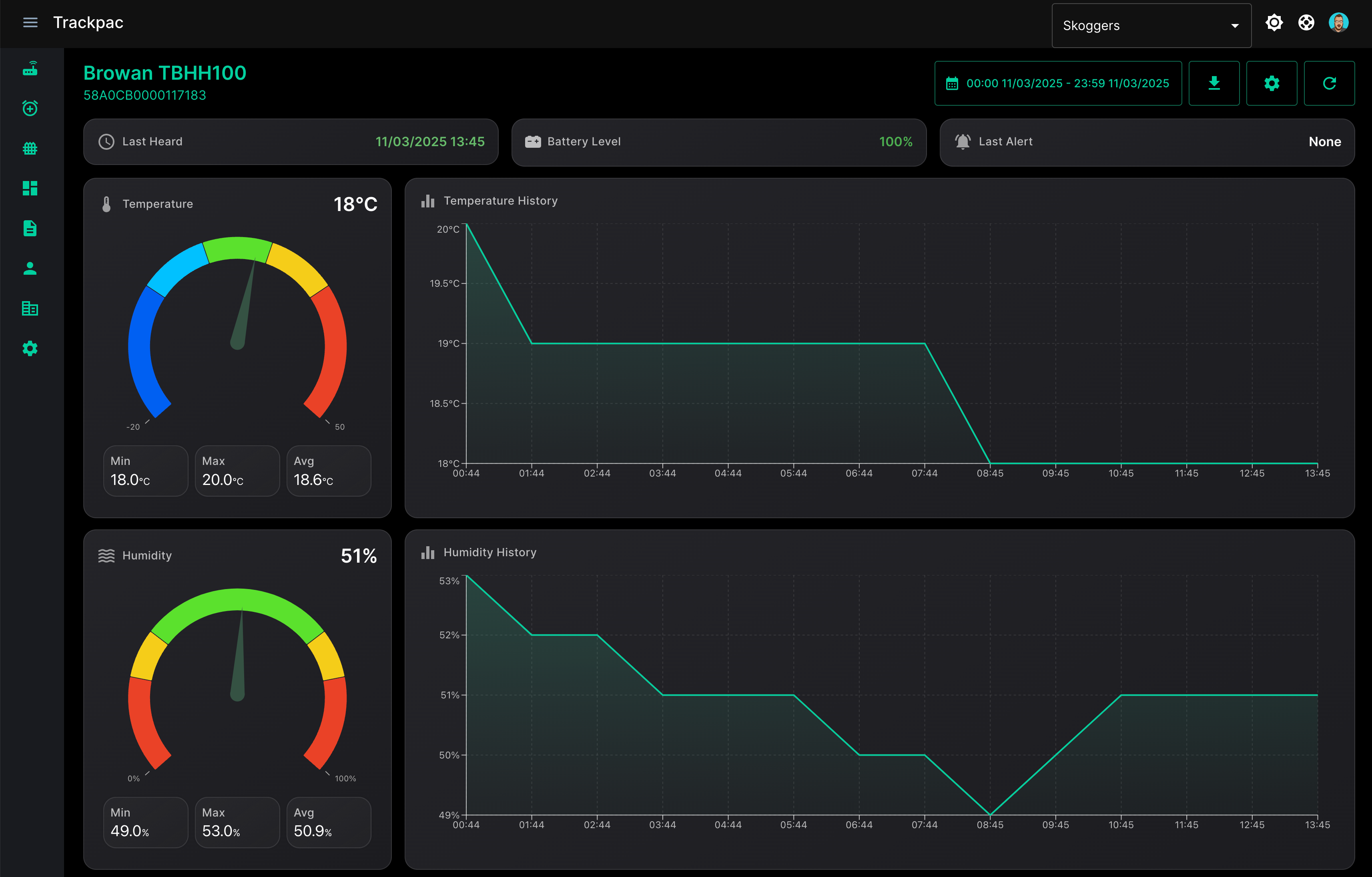
Trackpac's temperature monitoring platform pairs LoRaWAN temperature sensors with a dashboard built for exactly this: continuous readings, configurable alert thresholds, historical data you can review by exception, and reports you can hand straight to an inspector or auditor. Sensors run for months to years on battery power with no SIM card or per-message fees, so you can cover every cold store, walk-in, and display fridge without a growing connectivity bill.
For goods that move rather than sit still - pallets, totes, and deliveries that need to stay within range in transit as well as in storage - see our cold chain monitoring guide covering the RAK2270 sticker tracker, a low-cost, adhesive device built specifically for pallet- and package-level cold chain tracking.
Platform costs start from £15/device/year with no per-message fees. See our pricing page for full plan details, or talk to our LoRaWAN consultancy team about deploying sensors across cold storage, warehouses, and delivery routes.
Cold storage & walk-ins
Continuous monitoring of chillers, freezers, and cold rooms with alerts the moment a unit drifts out of range.
Warehousing & distribution
Cover multiple sites and units from one dashboard, with data shared across your team by organisation.
Frequently Asked Questions
What temperature does chilled food legally need to be kept at in the UK?↓
In England, Wales and Northern Ireland, the Food Safety (Temperature Control) Regulations 1995 set a legal limit of 8°C or below for food that could support the growth of harmful bacteria. The Food Standards Agency recommends running fridges at 5°C or below so that food stays within the 8°C limit even with door openings and loading. Scotland's equivalent regulations use a risk-based "no risk to health" standard rather than a fixed number, but 8°C (with 5°C as a working margin) is the practical benchmark food businesses use across the UK. Frozen food should be held at -18°C or below.
Is HACCP a legal requirement for UK food businesses?↓
Yes. Article 5 of retained Regulation (EC) No. 852/2004 requires every food business to have a documented food safety management system based on HACCP principles. You don't have to call it "HACCP" or use a specific format - the Food Standards Agency's Safer Food Better Business (SFBB) pack is a simplified, non-mandatory toolkit built to help smaller caterers and retailers meet this requirement - but some form of hazard analysis, monitoring, and record-keeping around critical points like chilling and cooking is legally required.
How long do I need to keep temperature monitoring records?↓
The FSA doesn't set one fixed retention period - it's for each business to decide, based on the shelf life of the food and the nature of the operation, per Regulation (EC) No. 852/2004's requirement to keep records "commensurate with the nature and size" of the business. Many food safety consultants recommend keeping completed diaries and sensor logs for at least 12 months as evidence of due diligence for EHO inspections and Food Hygiene Rating assessments - longer if a product has an extended shelf life or you supply into a sector with stricter contractual requirements.
Do I still need manual temperature checks if I have IoT sensors?↓
Continuous IoT monitoring replaces routine fridge/freezer spot-checks and gives you a far more complete record than a diary filled in twice a day, but it doesn't replace every SFBB check - things like probe ("prove it") checks on core food temperature during cooking and reheating are still done manually. Most food businesses run automated ambient monitoring for storage and transport alongside the manual checks their food safety management system already requires for cooking and handling steps.
What happens if an Environmental Health Officer finds gaps in my temperature records?↓
Gaps or inconsistencies in monitoring records are one of the most common findings in food hygiene inspections, and they undermine your ability to demonstrate due diligence - even if no food was actually affected. Depending on severity this can affect your Food Hygiene Rating, trigger a revisit, or in serious cases lead to improvement notices or prosecution. Continuous, timestamped sensor data is harder to fake or forget than a paper diary, which is why it's increasingly used as supporting evidence alongside - not instead of - a documented food safety management system.
How much does IoT temperature compliance monitoring cost?↓
Trackpac's temperature monitoring platform starts from £15/device/year with no per-message fees, on top of the cost of a LoRaWAN temperature sensor. For a specific quote covering your number of sites, sensors, and users, see our pricing page or talk to our LoRaWAN consultancy team.